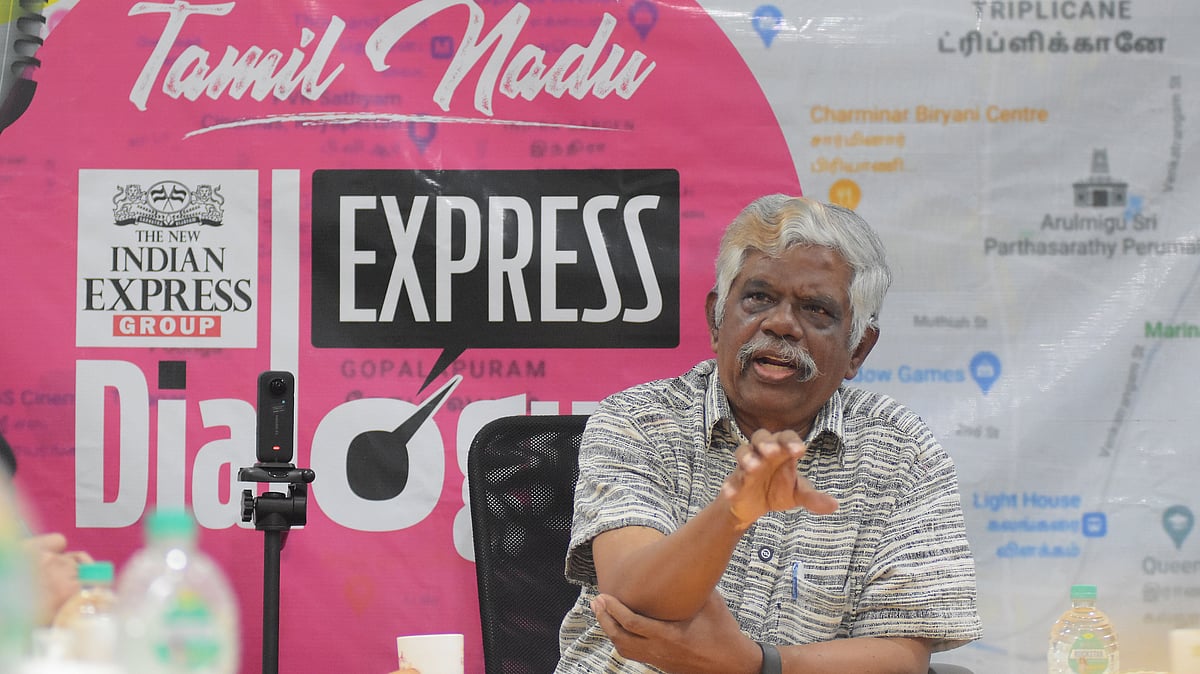
Express Dialogues | 'Tamil Nadu Governor perfecting Trojan horse art': Justice K Chandru
On the controversial communally-charged remarks being made by some judges of late
In a way, the judiciary is also a reflection of society. Judges are also drawn from society. We have different gradation of judges. Sub-standard, standard, a little higher standard. Within these, we also have politically-motivated judges. Irrespective of whether what they are saying is correct or not, they want to register their opinion.
For instance, on the issue of the ritual of devotees rolling over plantain leaves on which people had eaten, the ritual was stayed at least twice by courts. Now a third judge says it's a fundamental right to roll on leftover leaves and it is a part of a religious right.
Where do you get all this? There are judges who experiment like this. Therefore, you should have vigilant people to correct them. In another instance, a judge in Madurai, while hearing a case against the transfer of a policeman against whom there were a lot of complaints, said though she was of the opinion that the transfer order does not require any interference, her prarabdha karma required her to interfere. And therefore she set aside the transfer order. The police appealed. The division bench said the court is guided by the constitution and not karma. Why was the same enlightenment not there for the single judge?
Then there are also judges who write orders for social media or breaking news. They don't confine themselves to the case at hand. Besides, they deliver lectures outside.
It is not just about saffronisation, but also about putting wrong ideas into orders. Earlier, people were afraid to criticise judges, but today there is a strong criticism. Despite that, no one can remove the judges.
In the recent case of Judge Shekhar Kumar Yadav of Allahabad High Court, who made a controversial statement, the Chief Justice asked him to avoid such off-the-cuff remarks. Fifty five MPs gave a letter for impeachment. We do not know what the Supreme Court is going to do because technically the collegium is not a disciplinary authority. It can only deny work or transfer the judge to another place.
Chairman of Rajya Sabha and Vice President Jagdeep Dhankhar said removal of a judge is an exclusive right of the Parliament. That doesn't mean Parliament is asserting its right for removal. When he says the Supreme Court has not got the power (of removal), he is not talking about the constitution. He's talking about saving this man.
Impeachment as a method of removal of a judge did not work in this country. There is no removal at all. Where is the accountability?
On the never-ending tussle between Governor RN Ravi and the Tamil Nadu government
When the post of Governor was copied from the 1935 Government Act into the Constitution, they (framers of the Constitution) gave only a limited role for the post.
When Congress lost Assembly elections in eight states in 1967, they realised that opposition parties are in power in states. Then the governors started acting differently because they were asked to. Therefore, using governors to disturb state governments started in 1967.
Then the disturbances took different forms. For instance, governors are also chancellors of universities. Article 163 says governors are bound to act as per the aid and advice of the council of ministers headed by the chief minister. In the case of universities, they don't want to do that.
In 1976, when education was moved from the State to the Concurrent list of the Constitution, more concentration of power with the centre happened.
When the central government started (getting into) school education, they said CBSE schools will be only in cantonment areas and union territories. Today, you will find that 30% of schools are CBSE-affiliated. The Kothari Commission in 1965 said the central government should not enter into the area of school education.
In south India, which doesn't fall into the BJP's bandwagon, all four governors were sent with a message to create problems. The latest issue is about the governor’s insistence to include UGC chairperson’s nominees on the V-C search committees.
The appointment of Kalyani Mathivanan as the V-C of Madurai Kamaraj University was challenged, saying she didn't have the minimum qualification as per UGC norms. The Madras High Court ruled she was not fit to be a V-C. The Supreme Court curiously said, in the case of V-C appointments, the UGC regulations are recommendatory and the state government has not accepted (the regulations). Therefore Kalyani Mathivanan can be the V-C.
(However) the present governor (of Tamil Nadu) says unless you have a UGC representative on the committee there cannot be a selection (of V-C). How do we withdraw this power?
That's why Chief MInister MK Stalin now says bring education back to the State List.
The latest UGC (draft) regulations are an assault by the centre. With this, the BJP can capture the universities. They can appoint V-Cs of their choice. One way of saffronisation of education is through this method. Governors are used like Trojan horses. Governor RN Ravi is perfecting that art even though the Supreme Court has put inconvenient questions to him. However, I don't think he has any image among the people of Tamil Nadu.

Advertising by Adpathway







;)